This page is general information taken from official pages, not personal immigration advice. Rules change, so check the gov.uk English language guidance before you apply or book anything.
What the rule asks for
The gov.uk guidance says you prove your English for citizenship in one of two ways: with an English qualification at B1, B2, C1 or C2 level, or with a degree taught or researched in English. It also warns that a citizenship or settlement application will be refused if you send the wrong qualifications, so it is worth reading the rule before paying for a test.
Short version: approved test (speaking and listening, B1 or above), or a qualifying degree, or an exemption.
The test route: speaking and listening
The gov.uk page on secure English language tests (SELT) lists citizenship among the routes where you take a test that assesses speaking and listening.
On its page about IELTS tests for UK visas and immigration, ielts.org lists British citizenship as needing CEFR B1, with the components Listening and Speaking, and the test IELTS for UKVI Life Skills B1, with a Pass. The same page says UKVI only accepts tests taken in person at an official IELTS for UKVI test centre.
gov.uk also lists other approved providers and tests. This page does not compare them; the Home Office list is the place to see every option.
| Question | What the official pages say |
|---|---|
| Level | B1 or above |
| Skills tested | Speaking and listening |
| IELTS test listed | IELTS for UKVI Life Skills B1, Pass |
| Where it is taken | At an approved test location (IELTS for UKVI: in person at an official centre) |
| How long a result lasts | 2 years from the date the test is awarded |
The SELT page also says results must come from the two years before your application date, and that you should not contact the test centre directly about dates. Our pages on UKVI test centres and UKVI results cover the practical side.
Who is exempt
The exemptions page says you do not need to prove your English for citizenship if you are:
- aged 65 or over;
- unable to, because of a long-term physical or mental condition, in which case you provide a completed exemption form from a doctor and original copies of current medical reports;
- a citizen of one of the countries on the page's list, which includes Australia, Canada, New Zealand, the USA and the British overseas territories. Ireland is listed for citizenship only.
If you were exempt when you were granted settlement, the same page says you need to submit an exemption form again when you apply for citizenship. Read the full list there; it is long and may change.
An old or expired result
Two different situations are easy to mix up. A SELT is normally valid for two years, so a recent test must fall inside that window. But the approved qualifications page says that for citizenship, a B1, B2, C1 or C2 qualification that has run out can still be used if it was accepted when you settled in the UK. It adds that it does not matter if the test is no longer on the current list, and that you do not need to take another test.
If you are unsure which situation you are in, check the page rather than guessing: a wrong choice can lead to refusal.
The degree route
The degrees page says the degree must be academic; a vocational degree cannot be used. A degree awarded by a UK institution must have been taught or researched in English, and the page says it counts even if you studied outside the UK. A degree from outside the UK needs an assessment from Ecctis confirming it is equivalent to a UK bachelors degree or higher, and that it was taught in English. You also need the degree certificate, or an official transcript or university letter if the certificate is lost or not yet issued. Check the page for the exact documents.
The Life in the UK test is separate
The Life in the UK test is a separate requirement from the English proof described above. gov.uk describes it as 24 questions in 45 minutes based on the official Guide for New Residents, and says people under 18 or aged 65 or over do not need to take it.
If you are also planning settlement
Settlement and citizenship are different applications with different English steps. For the settlement side, see our page on ILR English tests. For visa routes where you might not need a test at all, see UK visa English test exemptions.
How lessons with Mike can help with this
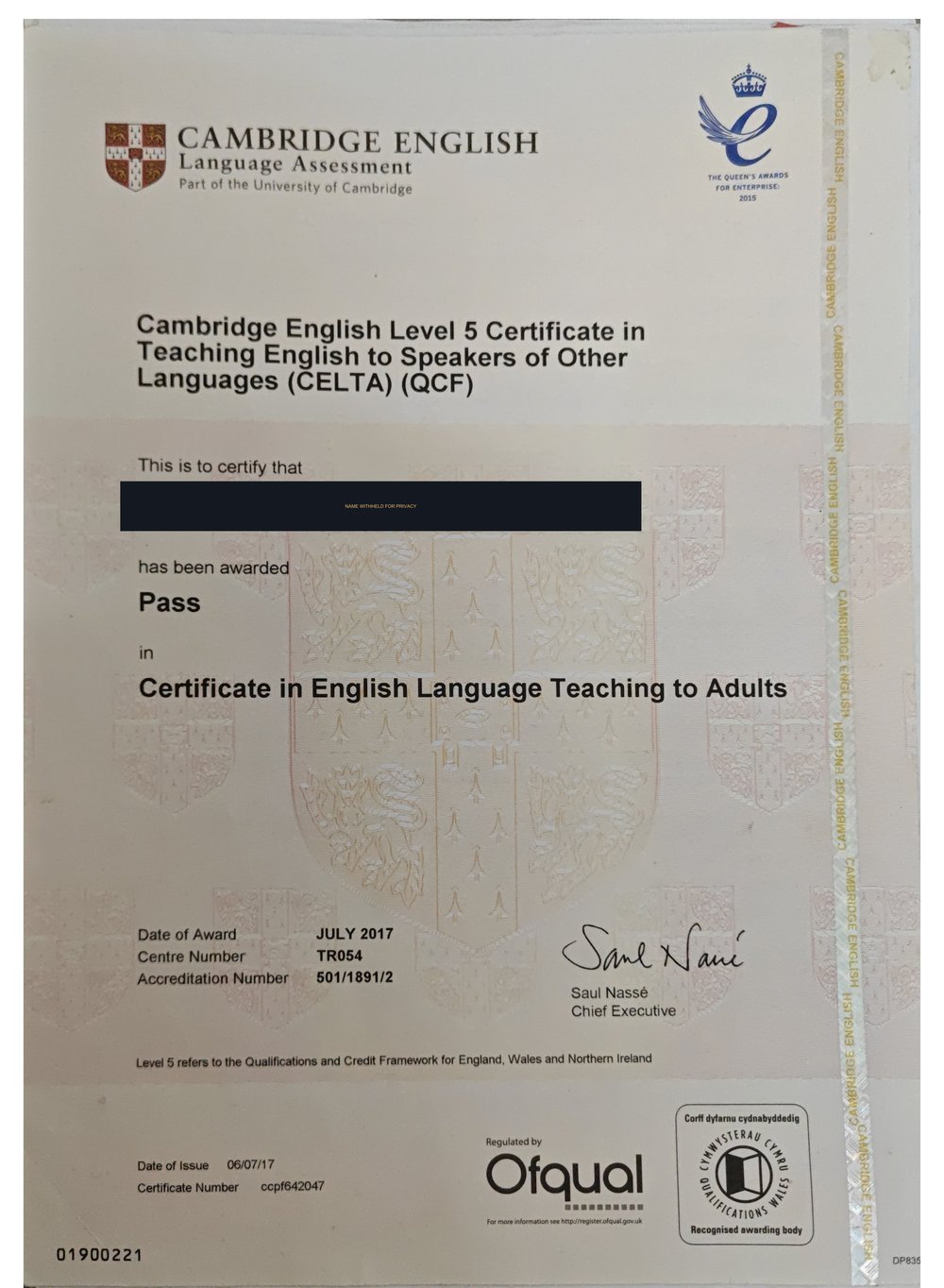
Mike teaches IELTS Listening, Reading, Writing and Speaking, and General English, one to one, live on Google Meet, in English. He holds a Cambridge CELTA (July 2017), is based in Hanoi, Vietnam, and has 12+ years teaching English and IELTS in Vietnam, Turkey and Iran. His own IELTS result is 8.5 in Speaking.
He does not coach for IELTS for UKVI Life Skills, and these lessons are not a route to a Life Skills result. What he can offer is general listening and speaking practice in English, which some learners find useful before any spoken test. The test itself is booked and paid for with the provider, not with us, and we are not a test centre. If that is what you want, you can book a lesson or read about Mike; the booking calendar shows each slot in your own time zone, and the exact price is shown before payment.