How the AI Speaking practice works
The practice test is part of My lessons on this site. You answer IELTS-style Part 1, Part 2 and Part 3 questions out loud, your browser turns your voice into text, and an AI writes a practice report from that text. The whole test takes about 12 minutes.
- Sign in. New here? Enter your email, type the six-digit code we send you, then choose a password. That creates your account.
- Check your microphone. The microphone check does not use up a test. Use Chrome, Edge or Safari, and allow the microphone when your browser asks. If you opened the page from inside another app, open it in one of those browsers instead.
- Tick the age box. Before the first recording, the page asks you to say that you are at least 18.
- Answer out loud. The questions appear on the screen one at a time: Part 1 (familiar topics), Part 2 (a cue card with a long turn) and Part 3 (a discussion linked to Part 2).
- Open your report. The report is saved to your account for 90 days, and a button shows or hides the text of your answers, so you can see the text the AI worked from.
Your account gets one included Speaking marking. You can spend it on a full test or on a single Part 2 answer from the Part 2 timer, which also asks you to sign in. Further markings are sold separately, and you see the price before paying for them. On some days all of the day's included markings have been given out, in some months the included markings are paused, and on a few days marking as a whole can be paused. The page says which, and your own included marking is not used up.
The IELTS Speaking test in brief
The IELTS website describes the Speaking test as a face-to-face interview of 11 to 14 minutes in three parts, and the General Training page gives the same three parts and timings. If you take IELTS Online, the interview takes place over a video call instead.
| Part | What happens | How long |
|---|---|---|
| Part 1 | An introduction and interview: general questions on familiar topics such as home, family, work, studies or interests. | 4 to 5 minutes |
| Part 2 | The long turn: you get a task card with points to include, one minute to prepare (you are given a pencil and paper for notes), and then you talk for 2 minutes and are stopped when the time is up. One or two questions on the same topic may follow. | 3 to 4 minutes, including the preparation time |
| Part 3 | A discussion of issues linked to the Part 2 topic, in a more general and abstract way. | 4 to 5 minutes |
Speaking is marked on four criteria: Fluency and Coherence, Lexical Resource, Grammatical Range and Accuracy, and Pronunciation. Each of them carries equal weighting (IELTS scoring in detail).
What is in the practice report
| Part of the report | What it gives you |
|---|---|
| Three marking areas | Fluency and Coherence, Lexical Resource, and Grammatical Range and Accuracy. Every area comes with a practice range and a comment on what you said. |
| An average | The average of those three practice ranges. The report states that Pronunciation is not included. |
| Three strengths and priorities | Three things you did well, then the points to work on next, with brief advice. |
| Three of your sentences, improved | A sentence from your answers, a stronger version with the same meaning, and why it is better. |
| Part 2 timing and speed | A note on how long your Part 2 answer lasted, and your words per minute in each part, worked out from the text and the seconds your answers took. |
| A note on the text received | If your browser's speech recognition made the text hard to read, the report says so. |
Treat the ranges as practice ranges only: they are no IELTS band, and the report says nothing about what a real test would give you.
Why Pronunciation is not marked
The real IELTS Speaking test is marked on four criteria: Fluency and Coherence, Lexical Resource, Grammatical Range and Accuracy, and Pronunciation. The AI practice reads the text your browser makes from your speech, and the way the words sound cannot be judged from text, so Pronunciation is left out and the report says so. A recognition program can also miss or change words, particularly with a strong accent, fast speech or background noise. If the report includes a note about the text received, read it before you trust a comment on a single word.
The AI practice test compared with the real test
| Compared on | AI Speaking practice | The real IELTS Speaking test |
|---|---|---|
| Who you speak to | A browser on your own device; questions appear on the screen. | An examiner, face to face or by video call. |
| Length | About 12 minutes for the full practice test. | 11 to 14 minutes. |
| Marked on | Three areas, from recognised text. | Four criteria, including Pronunciation. |
| Result | Practice ranges and written advice. | An official band score. |
AI Speaking practice or a teacher: who does what
| Compared on | AI Speaking practice | One-to-one with Mike |
|---|---|---|
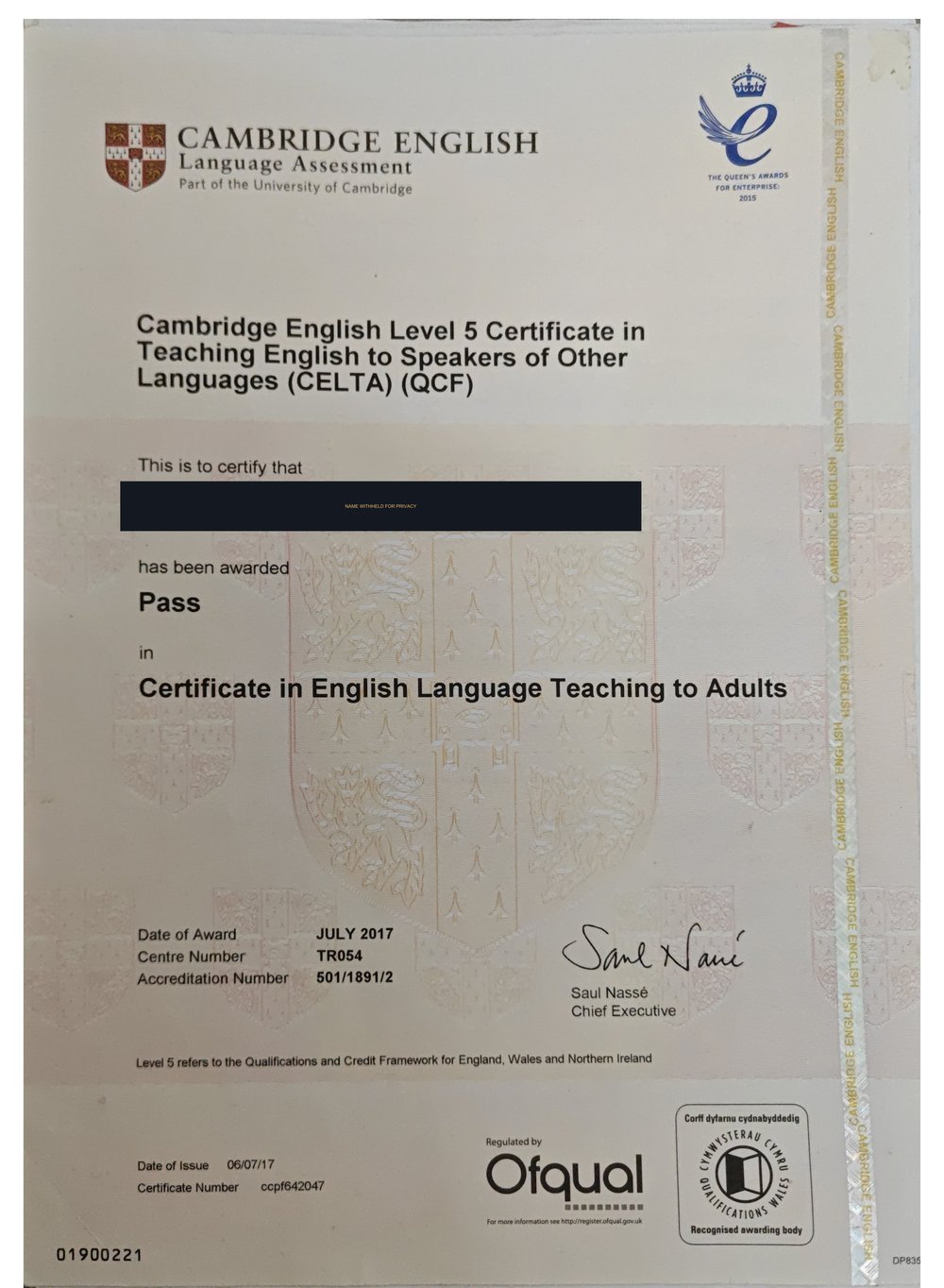
| Who listens | No person; an AI reads the text your browser produced. | Mike, a CELTA-certified teacher in Hanoi who scored 8.5 in IELTS Speaking, hears you live on Google Meet. |
| Pronunciation | Not marked. | Heard and commented on during the session. |
| Follow-up | None during the test. | Mike can ask a follow-up question and give feedback in the moment, so you can change something and try again. |
| Official score | None. Practice ranges only. | None. A teacher's feedback, not an official result. |
| Cost | One marking is included; others are sold, with the price shown first. | See the price on the booking page before you pay; the paid 30-minute trial can be taken once, on a first booking. |
One way to combine them is to use the AI test to see how much you can say in a timed attempt, and a session to work on Pronunciation and the reasons behind your habits. That is only one way, and no result is promised.
Check it yourself first
You can try these questions with the practice test closed. Say an answer out loud for about two minutes, record it on your own phone if you like, and answer each question while you listen back. They are plain-language versions of the public key assessment criteria and the Speaking band descriptors. No band is shown or implied: a 'no' is simply something to practise, and a row of 'yes' answers says nothing about what a real test would give.
Fluency and Coherence
- Can you keep talking at a steady, normal speed, without long stops to search for a word or many restarts and repeated phrases?
- Do your ideas come in a clear order, and does everything you say answer the question you were asked?
- Do you connect your sentences with linking words and pronouns (for example 'because', 'so', 'although', 'that') so that a listener can follow you?
Lexical Resource
- Do you use a variety of words, so you can talk about a topic at length without repeating the same few?
- When a word will not come, can you say the idea in other words and carry on?
- Do your words fit the meaning and the style (formal or informal), including words that usually go together?
Grammatical Range and Accuracy
- Do you mix in longer sentences that have extra clauses (for example 'when', 'which' or 'if') with your short ones?
- Do you use a range of verb forms, such as continuous, perfect, modal ('would', 'might') or passive forms, and not only one tense?
- Are many of your sentences correct from start to finish, and when there is a mistake, does a listener still understand you?
Pronunciation. The AI practice does not mark it, but the real test does. The IELTS key assessment criteria for Speaking include how much effort the listener needs to understand you, and only a listener can tell you how much effort that takes.
Count your 'no' answers in each area, then pick one point to practise before your next attempt.
An example report
Written for this page, not a real student. The answer and the report below are invented, to show how a Speaking report is laid out. It is a full-test report in short form: it shows one strength, one priority and one improved sentence where the real report lists three of each. A real report also gives a practice range for each area and an average of the three; none is shown here. The answer is written with punctuation to make it easy to read, and the text your browser makes from speech may have little or none.
Part 2 card (invented): Describe a street market that you enjoy visiting.
I want to talk about the night market near my house. I go there most weekends with my sister because the food is cheap and very tasty. Last time we tried a kind of grilled corn which I never eat before, and it was delicious. I think the nicest thing is the atmosphere, because everybody is relax and the music is playing.
| Report heading | Example wording (invented) |
|---|---|
| Note at the top | Practice feedback from an AI, based on the text of your answers. It is not an IELTS score and not a prediction. |
| Fluency and Coherence | Your answer has a clear order: the place, how often you go, what you ate and what you like. Your ideas are linked mostly with 'and' and 'because', so a wider choice of linking words would help. |
| Lexical Resource | Words such as 'cheap' and 'atmosphere' fit the topic. 'Tasty' and 'delicious' both describe the food, so a wider choice of describing words would show more range. |
| Grammatical Range and Accuracy | You use short sentences and some longer ones with 'because' and 'which'. Some word forms slip, for example 'relax' where 'relaxed' is needed. |
| Average of these three | A practice range (not shown here), followed by the sentence 'Pronunciation is not included.' |
| Your strengths | One example: you gave a specific detail, the grilled corn, instead of staying general. |
| What to work on next | One example: Talk about earlier experiences. When you describe something that happened before another event, practise forms such as 'had never eaten'. |
| Three of your sentences, improved | One is shown here. You said: Last time we tried a kind of grilled corn which I never eat before, and it was delicious. Try: Last time we tried a kind of grilled corn that I had never eaten before, and it was delicious. 'Never ... before' about an earlier experience needs 'had never eaten'. |
| Part 2 timing | A note says how long the Part 2 answer lasted compared with the two-minute limit, using only the seconds your answer took. A short list of words a minute for each part follows, worked out from the text and the seconds; its numbers are left out here. |
| Pronunciation note | A box says that Pronunciation is not assessed, because it cannot be judged from typed-out words, and that Mike can check it with you in a lesson. |
Use a report like this to choose one thing to practise, and keep in mind that it was written from recognised text and can be wrong.
Using the report well
- Look at the priorities first. Choose one to practise before you take the test again.
- Use the speed figures with care. Words per minute come from recognised text, so they show a pattern, not a fluency score.
- Practise Part 2 on its own. The Speaking Part 2 timer gives you the 1-minute preparation and the long turn, and the cue card list gives you topics.
- Keep personal details out. Do not say your name, phone number, address, school or workplace aloud.
What happens to your voice and text
This site does not receive or save your voice, only the text and timing numbers. To turn your voice into text, your browser uses a speech service run by the browser's maker, which may process the audio under its own privacy terms. Our server receives the recognised text and the number of seconds each answer took, then passes them to an AI service that writes the report. That service is not given your name, email address or account ID. Reports and answer text are deleted automatically after 90 days, sooner if you ask. You can open them while signed in, Mike can see them, and other students cannot. Full details are on the privacy page.
Where one-to-one Speaking practice with Mike fits
Band Booster IELTS is based in Hanoi and teaches IELTS mainly on Google Meet. Mike teaches every lesson himself, one-to-one on Google Meet by default. When you want a person to listen, start with the IELTS Speaking coaching page, which describes a session, or the online IELTS tutor page for the wider picture.
On the booking page you choose a time in your own time zone and see the price in your own currency before paying. The paid 30-minute trial can be booked once, on a first booking, and nothing is a subscription. The AI practice and the lessons are independent of each other, and neither one promises a band or a timeline.