What the AI Writing checker does
The checker is a part of My lessons on this site. You choose one Writing question, type your answer in a box and receive a written practice report from an AI. It works only from the words you typed: it does not read photographs or handwriting, it cannot ask you what you meant, and it does not mark Speaking (there is a separate AI Speaking practice for that).
- Sign in. A first-time visitor creates an account with a six-digit code sent to their email and a password they choose.
- Choose the task. Academic Task 1 (a chart, table, process or map, shown with the question), General Training Task 1 (a letter with three bullet points) or Task 2 (an essay). The built-in questions are practice questions written for this tool; they are not real exam questions. For Task 2 and letters you can instead type or paste your own question.
- Type your answer. An optional stopwatch lets you time yourself. An answer shorter than 60 words for Task 1 or 100 words for Task 2 is not marked, an answer longer than 450 words (Task 1) or 700 words (Task 2) is not marked either, and when an answer is shorter than the 150 words (Task 1) or 250 words (Task 2) that the task asks for, the report says so first.
- Confirm that you are 18 or over. You tick this box every time before your text is sent.
- Read your practice report. It stays in your account for 90 days.
The first Writing marking on each account is included. After that you can buy more markings, and the price is shown to you before you pay. On some days all of the day's included markings have been given out, and in some months they are paused. The page says so, your own included marking is not used up, and you can buy a marking in the meantime.
The IELTS Writing test in brief
According to the IELTS website, the Writing paper has two tasks, both must be completed, and it lasts 60 minutes in total (Academic format; General Training format).
| Detail | Task 1 | Task 2 |
|---|---|---|
| What you write | Academic: a description of a graph, table, chart or diagram. General Training: a letter, with three bullet points in the question that tell you what to include. | An essay that discusses a point of view, an argument or a problem. |
| Minimum length | At least 150 words | At least 250 words |
| Time to spend | About 20 minutes | About 40 minutes |
As the format pages above say, Task 2 contributes twice as much as Task 1 to the Writing score. Each task is marked on four criteria of equal weight, and the score for the task is their average: Task Achievement (Task 1) or Task Response (Task 2), Coherence and Cohesion, Lexical Resource, and Grammatical Range and Accuracy (IELTS scoring in detail). A General Training letter may be personal, semi-formal or formal in style, depending on the task.
What is in the practice report
| Part of the report | What it gives you |
|---|---|
| Four marking areas | Task Achievement (Task 1) or Task Response (Task 2), Coherence and Cohesion, Lexical Resource, and Grammatical Range and Accuracy. Each has a practice range and a short comment about your own text. |
| A range for the task | One combined practice range for this single task, with a reminder that Task 2 counts twice as much as Task 1 in the Writing band. |
| Three strengths | Specific points that refer to what you wrote. |
| What to work on next | Priorities, each with a short piece of advice. |
| Some of your sentences, improved | A sentence you wrote, a better version that keeps your meaning, and the reason for the change. |
| Length and time | How your word count compares with the task and, if you used the stopwatch, how your time compares with the suggested time. |
| One suggestion for your paragraphs | A concrete idea about the order of your ideas or the way you split them. |
The four marking areas are the public IELTS Writing criteria, as listed in the section above. The ranges in the report are practice ranges. They are not an IELTS band, and nothing in the report predicts the result of a real test.
What the checker does not do
- It does not give an official IELTS score, and it is not marking by an IELTS examiner.
- It does not predict your test result and it promises no band.
- It does not check whether an answer was copied or written by another person or program.
- It cannot hear you or ask you questions, and it does not mark Pronunciation or any other Speaking criterion.
- It is for adults aged 18 and over. If you are under 18, a lesson with Mike is available after a parent or guardian agrees; see the booking page.
An AI report can contain mistakes. Read it as one opinion about your text, and check a suggested correction against a grammar reference before you copy it.
AI feedback or a teacher: how they differ
| Compared on | AI Writing checker | One-to-one with Mike |
|---|---|---|
| Who reads your answer | An AI model, from the typed text only. | Mike, a CELTA-certified teacher in Hanoi, live on Google Meet. |
| What you can ask | Nothing during the report; you read it afterwards. | Why a sentence is a problem, what a better paragraph looks like, what to practise this week. |
| What you receive | A written practice report in your account. | Live corrections, with written progress notes afterwards in your account. |
| Official score | None. Practice ranges only. | None. A teacher's estimate against the public band descriptors. |
| Cost | The first marking is included; the price of more is shown before you pay. | The booking page shows your price before you pay; a paid 30-minute trial is available once, on your first booking. |
One way to use the two together is to draft an answer, read the report, rewrite it, and then take the version you still find difficult to a session. That is only one way of using them, not a promise of any result. Mike's own approach to marking is described on the IELTS Writing feedback page.
Check it yourself first
You can test your own answer before you open the checker, or instead of it. Read the answer slowly and say yes or no to each question below, one marking area at a time. The questions put the public IELTS Writing band descriptors into plain words. A 'no' is something to work on, not a mark. No band is shown or implied here, and a page of 'yes' answers does not tell you what the real test would give.
Task Achievement (Task 1) or Task Response (Task 2)
- Does your answer deal with every part of the task: all three bullet points of a letter, the main features of a chart, table or diagram, or each part of the essay question?
- Is your main point clear: an overview of the data (Academic Task 1), the purpose of your letter (General Training Task 1) or your position on the question (Task 2)?
- Is each main idea supported by something specific, such as figures from the data, a detail in your letter, or a reason and an example in your essay, and does everything you wrote relate to the task?
Coherence and Cohesion
- Are your ideas in a logical order, with a new paragraph for each main topic?
- Can a reader follow how each sentence leads to the next, without having to guess?
- Do your linking words and pronouns (for example 'however', 'this', 'which') each have a clear job, instead of the same few being repeated again and again?
Lexical Resource
- Do you vary your words, so that you are not using the same few for the same idea?
- Are your words right for the meaning and for the style of the task, including words that usually go together (for example 'make a decision', not 'do a decision')?
- Are the spelling and the word forms (for example 'decide', 'decision', 'decisive') correct in nearly every case, so that a reader rarely has to stop and work out a word?
Grammatical Range and Accuracy
- Do you use some longer sentences with more than one clause (for example with 'although', 'which' or 'if') as well as short ones?
- Do many of your sentences contain no grammar mistakes at all?
- Where a mistake remains, does your meaning stay clear, and is your punctuation under control, with full stops and commas where a reader expects them?
Count the 'no' answers in each area and start with the area that has the most. Change one thing at a time, then read the answer again. These questions paraphrase the descriptors and do not replace them, and they cannot tell you how a real marker would score an answer.
An example report
Written for this page, not a real student. The extract and the report below are invented, to show how a Writing report is laid out. The extract is the opening of a longer fictional Task 2 essay, and the report is for that whole essay. In a real report every marking area also gets a practice range, and a combined range for the task follows them; none is shown in this example.
Question (invented): Many cities are building more cycle lanes and fewer new roads. Do the advantages of this outweigh the disadvantages?
Nowadays many cities builds more cycle lanes and fewer new roads. I agree with this policy, because it make the air cleaner and it is good for people health. However, some people says that shops will lose customers if cars can not park near them. In my opinion this problem is smaller than the benefits.
| Report heading | Example wording (invented) |
|---|---|
| Note at the top | Practice feedback from an AI, based on the text you typed. It is not an IELTS score and not a prediction. |
| Task Response | Your position is clear from the first paragraph, and both sides of the question are covered. The reasons stay general, so add one specific example to each main reason. |
| Coherence and Cohesion | The opening paragraph states the position, and 'however' marks the move to the other side. Several sentences repeat the same 'because it ...' pattern; try joining ideas in different ways. |
| Lexical Resource | Your topic words suit the question. A word such as 'good' is easy to overuse, so try more exact choices such as 'healthy' or 'convenient'. |
| Grammatical Range and Accuracy | You mix short sentences with longer ones that use 'because' and 'if'. The verb does not always match its subject, for example 'cities builds', 'it make' and 'some people says'. |
| Your strengths | A real report lists three. One example: you state your opinion in the opening paragraph, so the reader knows your position from the start. |
| What to work on next | A real report lists three. One example: Check verb endings. When you finish, find the subject and the verb in each sentence and make sure they agree. |
| One of your sentences, improved | You wrote: I agree with this policy, because it make the air cleaner and it is good for people health. Try: I agree with this policy because it makes the air cleaner and is good for people's health. 'It' takes 'makes', and 'people's health' needs an apostrophe to show whose health is meant. |
| Length and time | Your answer is longer than the 250 words that Task 2 asks for. You used the stopwatch, and your time is close to the suggested time. |
| One suggestion for your paragraphs | Your second paragraph holds two separate ideas. Start a new paragraph for the second idea, with a first sentence that names its topic. |
| Last line | A closing line repeats that the report is practice feedback written by an AI. |
Read a report like this as one opinion about your text, and compare it with your own answers to the self-check above.
Using the report well
- Rewrite before you resubmit. Change the points in the priorities list. Each marking covers one answer, so a rewrite you send in uses another marking; compare its report with the first one.
- Keep your own voice. Use the improved sentences as models. Copying them without understanding them does not help you in an exam room.
- Practise under time. The stopwatch is optional, and the report comments on your time when you use it.
- Do not type personal details. Leave your name, phone number, address, school and workplace out of the answer, and sign a letter with a made-up name.
What happens to your text
Your draft stays on the page in your browser until you tick the box and press the button. Nothing is saved while you type, so a draft is gone if you leave or refresh the page. The text is then sent to our server and from there to an AI service, which writes the report. Your name, email address and account ID are not sent to that service. Your reports and the text of your answers are kept for 90 days and then deleted automatically; you can ask for earlier deletion. You can see them when you are signed in, and so can Mike; they are not shown to other students. The privacy page has the full details.
Where one-to-one Writing feedback with Mike fits
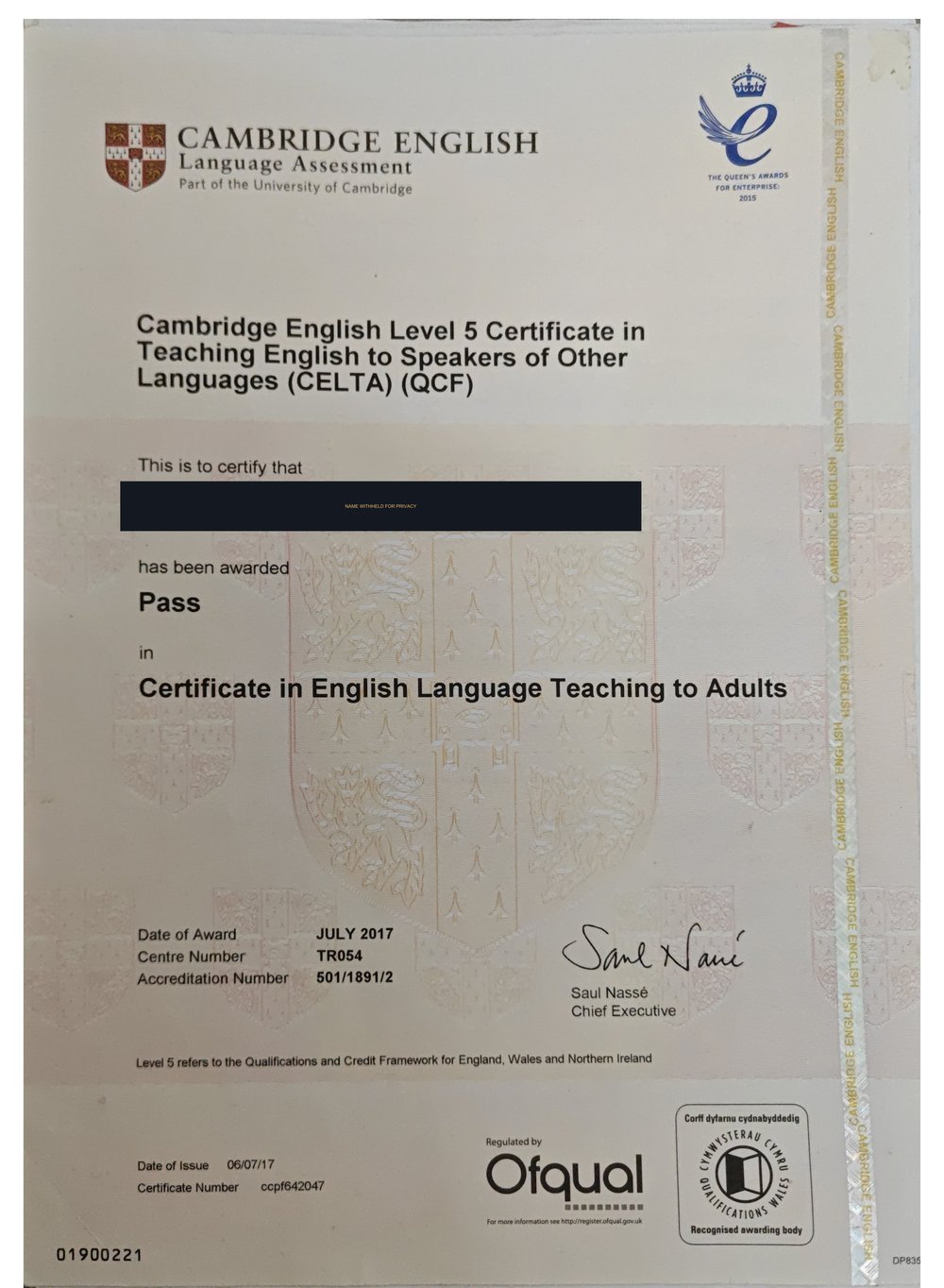
Band Booster IELTS is a coaching service based in Hanoi, Vietnam, with lessons mainly on Google Meet. Every session is taught by Mike, who holds the Cambridge CELTA and scored 8.5 in IELTS Speaking, and lessons are one-to-one on Google Meet by default. If you want a person to read your Task 1 or Task 2 answer with you, the Writing feedback page explains how a session works, and the online IELTS tutor page covers the rest of the format.
The booking page shows times in your own time zone and your price in your own currency before you pay. A 30-minute paid trial is available once, on your first booking. There is no subscription. Lessons and the AI checker are separate: using one does not require the other, and no band or timeline is promised by either.