The short answer: a class, or one-to-one?
Neither suits everyone. Five things are worth weighing, and the table shows the usual lean for each, as a rule of thumb only.
| Ask yourself | A group course at a centre often fits if... | A private tutor often fits if... |
|---|---|---|
| What is my starting band? | you are still building grammar, vocabulary and exam basics | you know which of the four skills is holding your band down |
| How much time do I have? | a course start date and length suit the weeks before your test | your test is close, or you want to choose when each session happens |
| What does my week look like? | a fixed day and time each week works for you | your week changes and you need to pick slots as you go |
| Do I need feedback on my own work? | general class feedback is enough, and you want classmates to practise with | you need your own Writing and Speaking corrected during the session |
| How do I want to pay? | you prefer one fee for a set course, which can cost less per hour | you prefer to pay per session, only for the hours you book |
In Vietnamese the same question reads nên học IELTS ở trung tâm hay gia sư? or học IELTS 1 kèm 1 hay học lớp?; the Vietnamese version of this page answers it.
Starting band: basics first, or one weak skill?
A group course is planned around the class as a whole, so the pace may be set for the group rather than for one student; how much depends on the centre. While you are building basics, that structure can help. If your Writing is well below the rest of the class, though, the lesson may move faster than you can follow, and the reverse can happen if you are the one ahead.
A one-to-one session has no class average to aim for, so the session time can go to wherever your band is stuck: more on Writing Task 2 if that is the gap, more on Speaking Part 3 if that is where marks are lost. No band cut-off decides the choice, and this page gives none. If your English feels rusty, start with IELTS from scratch. The online IELTS tutor page shows how a session is structured.
Time and schedule: a fixed timetable, or a slot you choose
Some group courses run on a timetable set by the centre: the same day and time each week for the length of the course. That suits a steady routine and can be harder to fit around shift work, travel or a changing week; options differ between centres, so ask.
One-to-one sessions with Mike are booked from a live calendar, and each time is shown in your own time zone (Hanoi is UTC+7 all year, according to the IANA time zone database). Open slots depend on his calendar, so if you can study only at fixed hours, check the booking page first. If your test is close, you can book several sessions in the same week when slots are open (see intensive IELTS prep in Hanoi).
No course length or number of sessions promises a band: ielts.org says there is no single answer to how long it takes to raise a band, because many factors affect it (see also the band improvement timeline).
Feedback: in the same session, or shared across a class
In a larger class the teacher's attention is spread across more students, so feedback on your own Task 2 essay or Speaking answer may take longer to arrive, or be shorter, than it would one-to-one. Whether it does depends on the class size and the centre.
In a one-to-one session, Mike gives feedback on your Writing and Speaking during the session, while the answer is still fresh, not days later. The pages on IELTS Writing feedback and IELTS Speaking coaching show how each skill works.
Whoever gives the feedback, check what it is measured against. According to ielts.org's scoring page, Speaking is scored on four criteria that carry equal weighting, and Writing is scored on four equally weighted criteria, with Task 2 carrying more weight than Task 1. The band descriptors are public: Speaking and Writing (both PDFs). Ask a centre or a tutor which criterion is costing you marks.
Budget: one fee per course, or pay per session
Some group courses are priced as one fee for a fixed number of weeks, so ask how a centre charges. Refund, make-up and absence terms can also differ between centres, so ask for them before you pay. Depending on the centre, a group course can cost less per hour than one-to-one coaching, which can make it the more economical route if you mainly want structure.
Band Booster IELTS charges per session instead of a course fee. There is no subscription and no required pack, and you pay only for the sessions you book. The booking page shows your price in your own currency before you pay, along with the payment options.
Questions to ask an IELTS training centre before you pay
- How many students are in a class, and does the same teacher take every lesson?
- How is my Writing marked, and how soon does it come back?
- How much speaking time does each student get in a lesson?
- What does the fee cover, and what happens if I miss a lesson?
- Can I try a lesson before I commit to the whole course?
The same questions work for a tutor; see how to choose an online IELTS tutor for more, with red flags to watch for. If a centre or tutor advertises a fixed result, ask what conditions apply and get them in writing.
When a group course at a centre fits better
- You are still building basics, such as grammar, core vocabulary and exam format, rather than polishing a band you already have.
- You want peer practice: discussion partners, group Speaking drills and other students to compare your English with.
- Cost per hour matters more to you than individual correction.
- A fixed weekly slot suits your routine and you do not expect to move it.
When a private tutor fits better
- You have taken a practice test or the real exam and know roughly which of the four skills is capping your score.
- You need your own essays and your own speaking corrected, not general class material.
- Your schedule does not fit a fixed weekly class.
- You are working to a real deadline, such as a visa, a university offer or a job, and want every session spent on your weakest skill.
A tutor is not automatically more effective than a class: one-to-one time is only as useful as the teacher and the work you do between sessions. You can also use both, with a course for the basics and one-to-one sessions for the skill still below your target.
Do you have to use either one?
Going by ielts.org's preparation page, read in October 2026, it does not say that a course or coaching is required. It lists options such as sample tests, Writing videos, apps, webinars, books, articles and teacher-led courses, and says teacher-led courses can help you learn and practise English. The page we read does not mention private tutors. See Do you need IELTS coaching, or can you study alone? for what you can check yourself.
Who teaches the one-to-one sessions
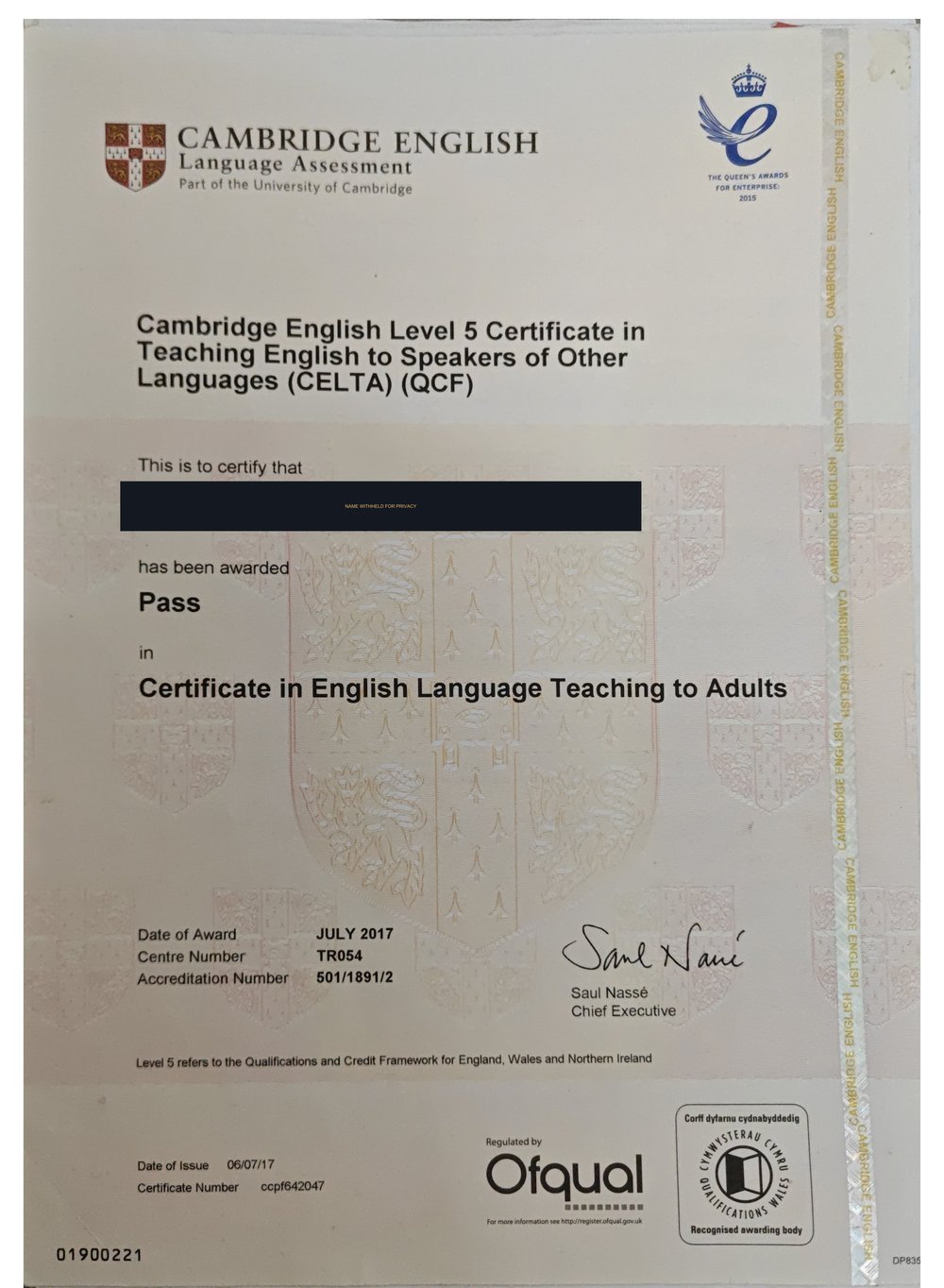
Every session at Band Booster IELTS is taught by Mike himself, not a rotating team of tutors, live in English on Google Meet. He holds the Cambridge CELTA and is based in Hanoi. His own IELTS result is 7.5 overall, with 8.5 in Speaking. More is on the about Mike page.
Lessons are one-to-one by default and never shared with strangers, so if you want classmates to practise with, a class suits you better. Mike is a teacher, not the exam board. No band, outcome or timeline is guaranteed: progress depends on your starting point and the work between sessions.
Booking and trying it first
Sessions run on Google Meet. You can reschedule at no charge up to 24 hours before a session; a cancellation inside 24 hours is not refunded.
Not sure which fits? The paid 30-minute trial session, taught by Mike and bookable once on your first booking, lets you see one-to-one teaching before you book more. Book a trial session; the booking page shows your price before you pay.