How lessons work for learners in Poland
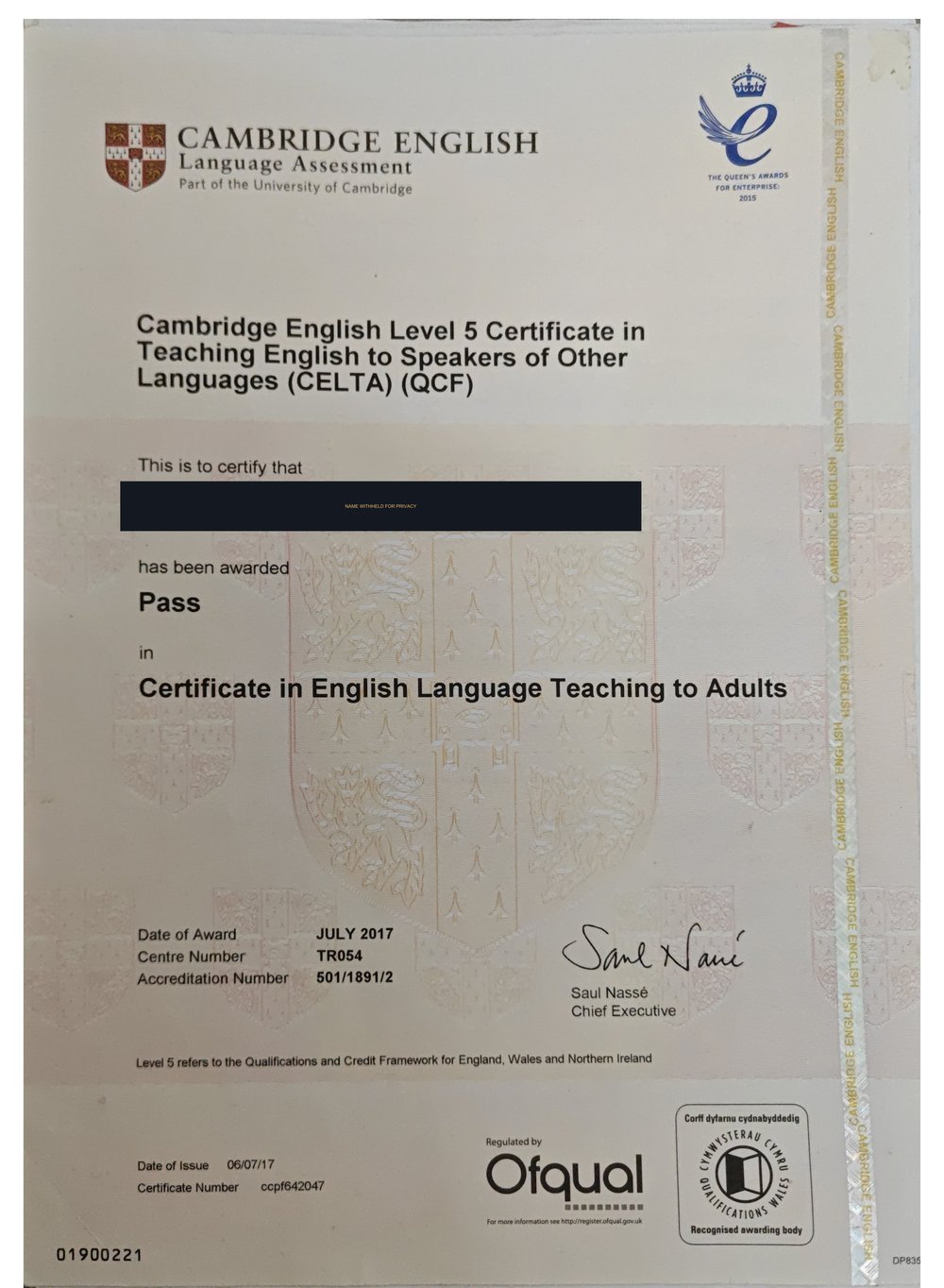
You work with one teacher. Mike holds the Cambridge CELTA (July 2017), lives in Hanoi, and has 12+ years of experience teaching English and IELTS in Vietnam, Turkey and Iran. In his own IELTS he scored 8.5 in Speaking. You can read more on About Mike.
The lessons are one-to-one and live on Google Meet, in English. Each session can cover Listening, Reading, Writing or Speaking, or a mix, and there is no fixed course. You decide what to work on, and Mike adjusts as you go.
| Term | What applies |
|---|---|
| Format | One-to-one, live on Google Meet, in English |
| Lesson length | 60 minutes; a paid 30-minute trial is possible once, on your first booking |
| Commitment | No subscription and no package: book sessions when you need them |
| Rescheduling | At no charge up to 12 hours before the slot |
| After payment | Google Meet link and calendar invite arrive by email |
What a session covers
- Writing: Mike marks Task 1 and Task 2 against the public band descriptors.
- Speaking: Parts 1 to 3 in the real format, with feedback in the moment rather than days later.
- Listening and Reading: practice and the habits that cost marks.
- Progress notes: written notes after sessions, kept in your account.
For more detail see IELTS Speaking coaching and IELTS Writing feedback.
Poland and Hanoi: the time difference
Poland's official time is Central European Time in the ordinary period, with summer time one hour later, according to the Central Office of Measures (GUM) (an archived news item, so check the current rule if the clock changes are ever altered). Hanoi stays on UTC+7 all year with no clock change. So Hanoi is 6 hours ahead of Poland in winter and 5 hours ahead in summer. A lesson at 19:00 in Hanoi is 13:00 in Poland in winter and 14:00 in summer.
You do not need to do the sums. The booking calendar shows every slot in your own time zone. Open slots depend on Mike's calendar, and no particular hours are promised, so if you can only study at fixed times, check the calendar first.
Booking and payment
- Open the booking page and choose a slot.
- See your price on the booking page before you pay. PayPal charges the US-dollar equivalent and shows the exact amount at checkout; you can pay by card through PayPal. USDT is also accepted.
- Receive the Google Meet link and calendar invite by email right after payment.
- Join the lesson at the time shown in your own time zone.
If you are under 18, a parent or guardian first agrees to a short consent letter before the booking is made.
Booking the IELTS test itself in Poland
Band Booster is not a test centre and does not register candidates or set exam fees. You book the test with a provider. IELTS is jointly owned by the British Council, IDP IELTS and Cambridge University Press & Assessment, and the ielts.org centre finder for Poland lists test venues in Lublin, Kraków, Katowice, Wrocław, Warsaw, Szczecin, Gdańsk and Poznań, including more than one in Warsaw. A Warsaw British Council centre is marked as UKVI Approved there. The finder is a live list that can change, and it shows which provider runs each venue, so check it on the day you plan your test.
IDP Poland lists IELTS on computer for Academic and General Training and also IELTS Online for Academic, and its test search names Bydgoszcz, Poznań and Warsaw. The two sites do not list exactly the same cities, so check both before choosing a date. Fees and dates are set by the provider and change, so this page states none.
According to ielts.org, the IELTS Academic test takes 2 hours 45 minutes: Listening about 30 minutes, Reading 60 (including transfer time), Writing 60 and Speaking 11 to 14 minutes. General Training has different Reading and Writing content, so these timings are the Academic ones. Check which version your university, employer or immigration body asks for on its own page.
All guides for Poland
- IELTS Online in Poland
- IELTS and the NMC
- IELTS fees and dates in Poland
- IELTS for UKVI
- IELTS in Warsaw
- IELTS test centres in Poland
How lessons with Mike can help with this
Lessons help you practise the four skills in a calm, structured way before you sit the test: Writing marked against the band descriptors, Speaking in the real three-part format, and a clear picture of what to do between sessions. No band score or timeline is promised, because progress depends on where you start and how much you practise. If you are weighing options, how to choose an online IELTS tutor lists questions worth asking any teacher. When you are ready, choose a slot.