Do you need IELTS for UKVI for a Student visa?
It depends on your course and your university, so there is no single yes or no. GOV.UK's page on knowledge of English says you may need to prove your English when you apply for a Student visa. It lists several ways, and a test from an approved provider (a Secure English Language Test, or SELT) is only one of them.
The ways listed are:
- a UK school qualification that you began when you were under 18;
- a degree awarded by a UK institution, taught in English;
- a degree from outside the UK taught in English, assessed by Ecctis;
- an approved English test;
- for degree-level courses, an assessment by your Higher Education Provider (HEP).
GOV.UK says some nationalities are exempt, and so are some applicants who proved their English in an earlier visa application. Read the exact list on that page rather than relying on a summary.
What level is required: B2 or B1?
GOV.UK sets the level by the course you will study. You must show you can read, write, speak and understand English at the level below.
| Course level | CEFR level (GOV.UK) | IELTS figure on ielts.org |
|---|---|---|
| Degree level or above | B2 | IELTS or IELTS for UKVI, at least 5.5 in each of four skills |
| Below degree level | B1 | IELTS for UKVI, at least 4.0 in each of four skills |
The IELTS figures come from ielts.org's page on IELTS for UK visas and immigration, not from GOV.UK. That page also tells readers to confirm their requirements on the government website or with the organisation receiving them. Your university may ask for a higher score than the visa minimum, so the university's own entry requirement matters as much as the visa.
When can the university assess your English itself?
For degree level or above, GOV.UK says your Higher Education Provider can assess your English itself. If it asks for a different test, the result must still be equivalent to B2. The Immigration Rules, in Appendix English Language, set out the same idea. A degree-level sponsor with a track record of compliance may state on your Confirmation of Acceptance for Studies (CAS) that it has assessed your English. The CAS must then confirm English equivalent to B2 or above in all four components: reading, writing, speaking and listening. The appendix also sets out an alternative to the CAS statement, so read it for the full rule.
In practice, this means two applicants for similar courses can be asked for different things. One may be told to send an IELTS for UKVI result, another may be told the university has accepted a different kind of evidence. The only safe sources are your own offer letter, the university's English requirement page and GOV.UK.
Why the university may still ask for a test
UCAS says the level you need varies from university to university, and can differ between courses at the same university. It says universities usually accept results from several test providers, and some accept other evidence such as earlier school qualifications. If you fall short, many universities offer a pre-sessional English programme before the course starts, so ask the admissions team what they offer.
IELTS or IELTS for UKVI: how to decide
Work through these steps in order:
- Read your university's English language requirement for your exact course.
- Check whether your course is degree level or below, because that sets B2 or B1.
- Ask admissions, in writing, whether they will assess your English themselves or want a test result.
- If a test is needed, ask which version of IELTS is accepted for your course and which scores per skill. ielts.org lists IELTS for UKVI for courses below degree level.
The difference between the two tests is covered on IELTS for UKVI or standard IELTS, and the full list of scores by route is on IELTS score for a UK visa by route.
Common questions before you book a test
- Is my result valid for the visa as well as the university? Only your university and GOV.UK can confirm that for your case. Ask before you pay.
- I studied my degree in English abroad. GOV.UK says you can have your degree assessed by Ecctis, which gives a code confirming it is equivalent to a UK bachelor's degree or higher and was taught in English.
- I am under 18. GOV.UK says a Student visa is open from age 16. Younger learners at independent schools may be looking at a different visa, so read the official page.
What happens after you finish your course?
If you later apply for a Graduate visa, GOV.UK's eligibility list names being in the UK on a Student visa, studying an eligible UK course, successfully completing the course and your provider informing the Home Office. It lists no English test. Check the page for the current rules before you plan.
How lessons with Mike can help with this
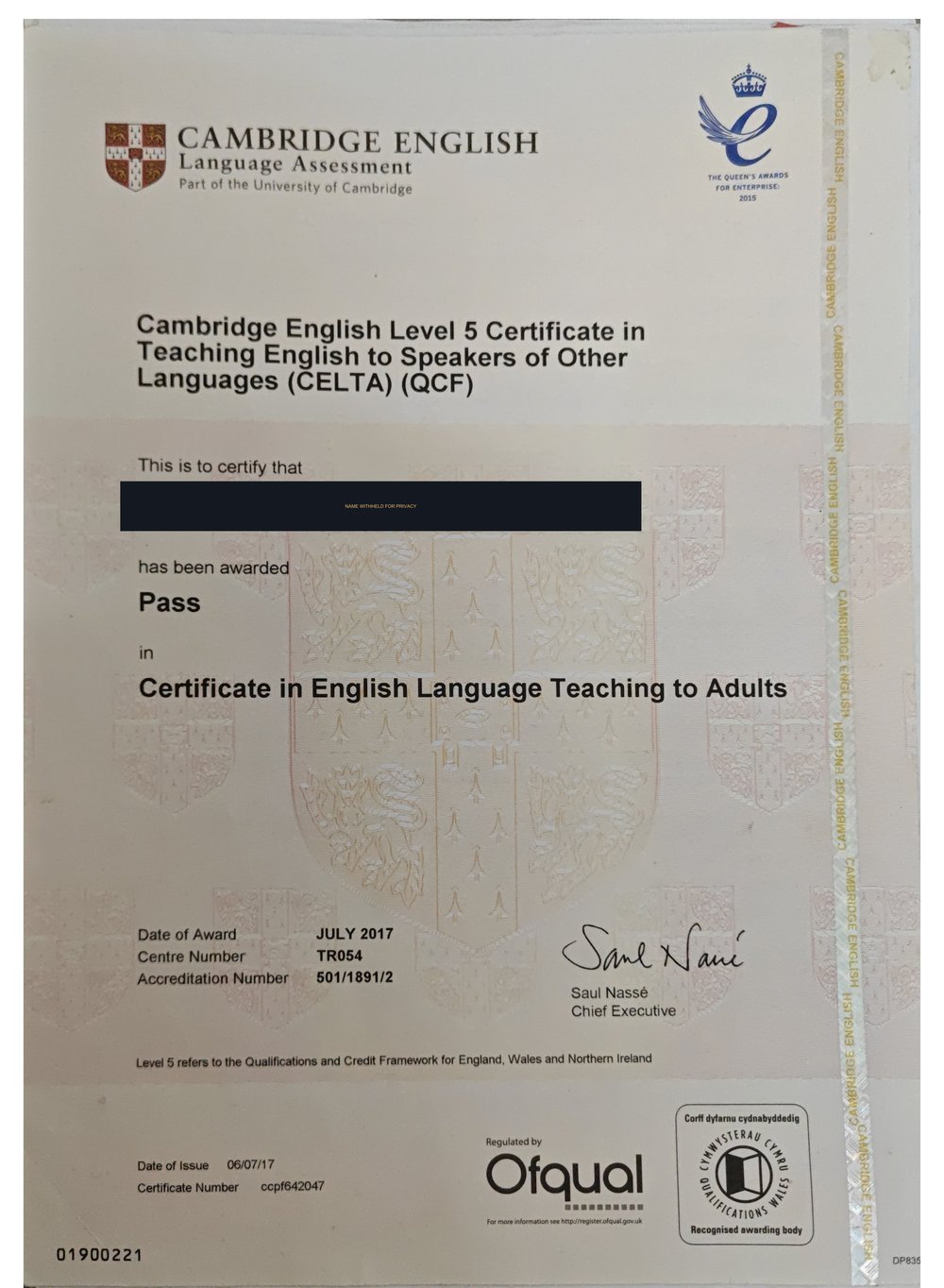
Band Booster IELTS is a private tutoring service. It is not a test centre, it is not the exam board, and it does not register candidates, set fees or advise on visa applications. Mike is a Cambridge CELTA-certified teacher based in Hanoi, with 12+ years teaching English and IELTS in Vietnam, Turkey and Iran. His own IELTS result includes 8.5 in Speaking. He teaches every session himself, live on Google Meet, in English.
If your university or visa route needs a test, lessons can help you prepare for IELTS Listening, Reading, Writing and Speaking. Mike marks Writing Task 1 and Task 2 against the public band descriptors, and runs Speaking Parts 1 to 3 in the real format with feedback in the moment. He leaves written progress notes in your account. No band is promised, because progress depends on where you start and the work between lessons. If you are under 18, a parent or guardian first agrees to a short consent letter before the booking is made.
The booking page shows each slot in your own time zone and the exact price before payment. A paid 30-minute trial is available once, on your first booking. You can read more about Mike first.