The short answer
Two questions get mixed up. The first is whether the scholarship asks for IELTS when you apply. The second is whether the university where you want to study asks for it. For Chevening and the Commonwealth Scholarship Commission (CSC), the official answers to the first question are different from the answer to the second, and you need both.
| Question | What the official page says |
|---|---|
| Does Chevening require an English score to apply? | No. Its guidance page says it does not require you to submit one, and that many UK universities do. |
| Was there ever a Chevening English requirement? | Yes, and it was removed in 2020, according to the Chevening FAQ. |
| Does the CSC require IELTS to apply? | No. Its FAQ says an IELTS or other English certificate is not necessary to apply. |
| Who checks the university's English rule? | For the CSC, you do. Its FAQ says it is your responsibility to check the requirements directly with the university. |
Chevening
The Chevening FAQ says the programme's English language requirement was removed in 2020. It adds that candidates still need to meet all requirements from their chosen university, and that they must secure an unconditional offer from one of their three course choices by the deadline on the application timeline. The FAQ page itself does not give the deadline date, so read the timeline page for the current one.
Chevening's own pages say no English language score is required with the application, and that many UK universities do ask for one. Read your university's course page for its rule, and the Chevening pages for how that rule fits the offer you need.
Commonwealth Scholarship Commission
The CSC FAQ says it is not necessary to have IELTS or any other English language certificate to apply. It then notes that UK universities require candidates from some countries to demonstrate their English proficiency. The Commission's Master's scholarships page says the CSC does not require any candidates to take an IELTS test. The same page says many courses have strict admission deadlines and candidates should check admission requirements carefully.
Check the dates on the pages. The Chevening guidance page shows a 2021 copyright footer and the Master's page carries a September 2020 post date. Rules can change, so open the live scholarship page before you plan around any of this.
Where the university condition comes in
Each university sets its own English entry rule, and it can differ between courses at the same university. A few things to look for on the course page:
- the overall score and any minimum per skill, if IELTS is accepted;
- other tests or qualifications the university accepts instead;
- whether your nationality or earlier degree changes the requirement;
- how recent the test result must be at the time of the offer;
- whether an offer is conditional on the English score or unconditional.
For worked examples of how three universities state this, see IELTS at Imperial, LSE and Edinburgh. For the separate question of the student visa, see IELTS for a UK student visa. A scholarship does not replace either of these steps.
What this does not tell you
- It does not say you will not need IELTS. Your university may still ask for it.
- It does not cover other scholarships. Each scheme has its own page and its own rules.
- It does not say whether any English test result helps your selection chances. The official pages quoted here do not claim that, so neither does this page.
- It is general information from public pages, not personal advice on your application.
A sensible order of steps
- Read the current scholarship eligibility page and note its deadlines.
- Open the English requirement page of each course you are considering.
- If a score is needed, work out which skill is furthest from the target, since some universities set a minimum per skill.
- Book the test with a test provider early enough for the result to reach the university before its own deadline. The IELTS website points to the test providers and test centres.
- Keep a copy of the university's written English requirement for your own records.
How lessons with Mike can help with this
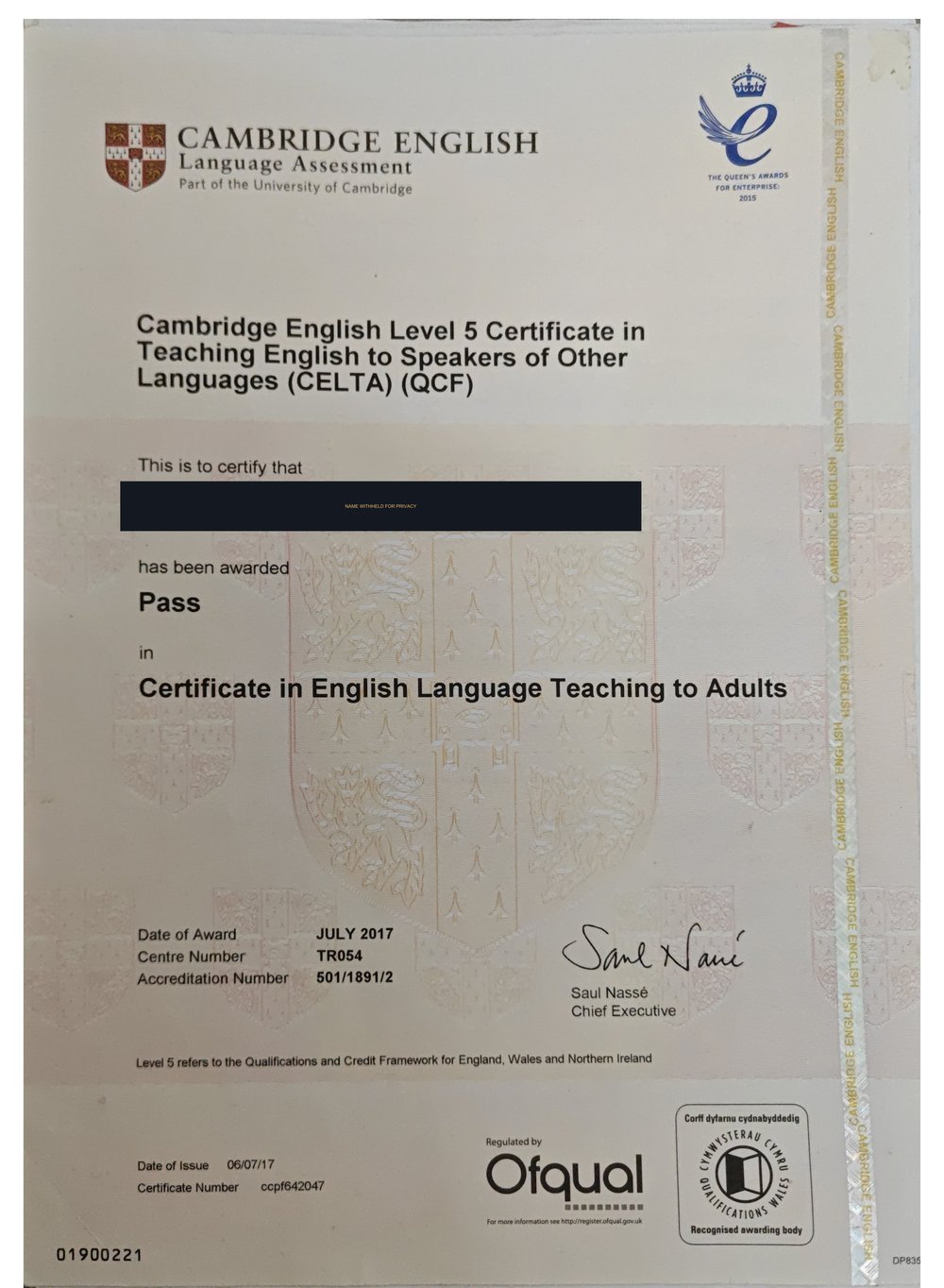
If your chosen course needs an IELTS score, lessons are one to one, 60 minutes, live on Google Meet, in English. Mike marks Writing Task 1 and Task 2 against the public band descriptors, runs Speaking Parts 1 to 3 in the real format with feedback in the moment, and leaves written progress notes in your account. He holds a Cambridge CELTA (July 2017), has 12+ years teaching English and IELTS in Vietnam, Turkey and Iran, and his own IELTS result is 8.5 in Speaking.
Lessons cover IELTS Listening, Reading, Writing and Speaking. They do not replace reading the scholarship and university pages, and no lesson can promise a score. If you want to try, there is a paid 30-minute trial, available once per student on a first booking. You can see open times in your own time zone and read more about Mike.