Who the requirement is for
The Teaching Council's English language requirement page is addressed to applicants for registration who have qualifications from outside Ireland. They must satisfy the Council that they have the necessary knowledge of English to communicate effectively. Whether it applies to your own application is for the Council to confirm; this page is general information, not personal advice.
The five kinds of evidence
The Council asks you to provide one of the following. IELTS is only one of them, so check whether another route already fits your history.
| Evidence | What the page says |
|---|---|
| Qualification in English | A teacher education or undergraduate qualification acquired and examined through English. If English is not the vernacular where you studied, a letter from the institution must confirm English was the language of instruction and examination. |
| IELTS Academic | A certificate with a score of 7.0 or above. |
| Living and working in English | Living and practising in a professional capacity through English in a country where English is an official language, for three of the preceding five years. |
| Living and studying in English | Living and undertaking a programme of learning through English in such a country, for three of the preceding five years. |
| Cambridge C1 Advanced | A minimum of Grade C. |
The IELTS conditions in detail
- Academic module. The page names IELTS Academic. It does not mention General Training, so ask the Council before booking a General Training sitting.
- 7.0 or above. The page says "a score of 7.0 or above" and nothing more. It does not say whether that is the overall band or a minimum in each of Listening, Reading, Writing and Speaking. Do not assume either; confirm with the Council.
- One sitting. All components of the IELTS or Cambridge test must be attempted at the same sitting, so results combined from different sittings are not what the page describes.
- Verification. The Council reserves the right to verify scores independently with IELTS or Cambridge.
The page does not mention IELTS One Skill Retake or IELTS Online. If you are thinking of either, ask the Council first. The page on One Skill Retake in Ireland explains what the providers say about that option.
How old the test may be
The test must have been taken no more than five years before the date you submit your application. The alternative is to provide evidence that you have lived and worked or studied on a full-time basis in an English-speaking environment since completing the evaluation. This five-year window is the Teaching Council's own rule. Other bodies set their own limits, so do not carry this one over to a different application.
Sending the evidence
The Council says the evidence must be supplied with your registration application, because registration cannot be finalised without it. That makes timing worth planning: if your certificate is close to five years old, work out the submission date before you rely on it.
Booking the test
IELTS is run by test providers, not by this website. For venues in Ireland, see IELTS test centres in Ireland and where to check dates and fees. Fees and dates change, so they are not stated here. Other Irish registration bodies set different rules; the comparison page shows them side by side.
How lessons with Mike can help with this
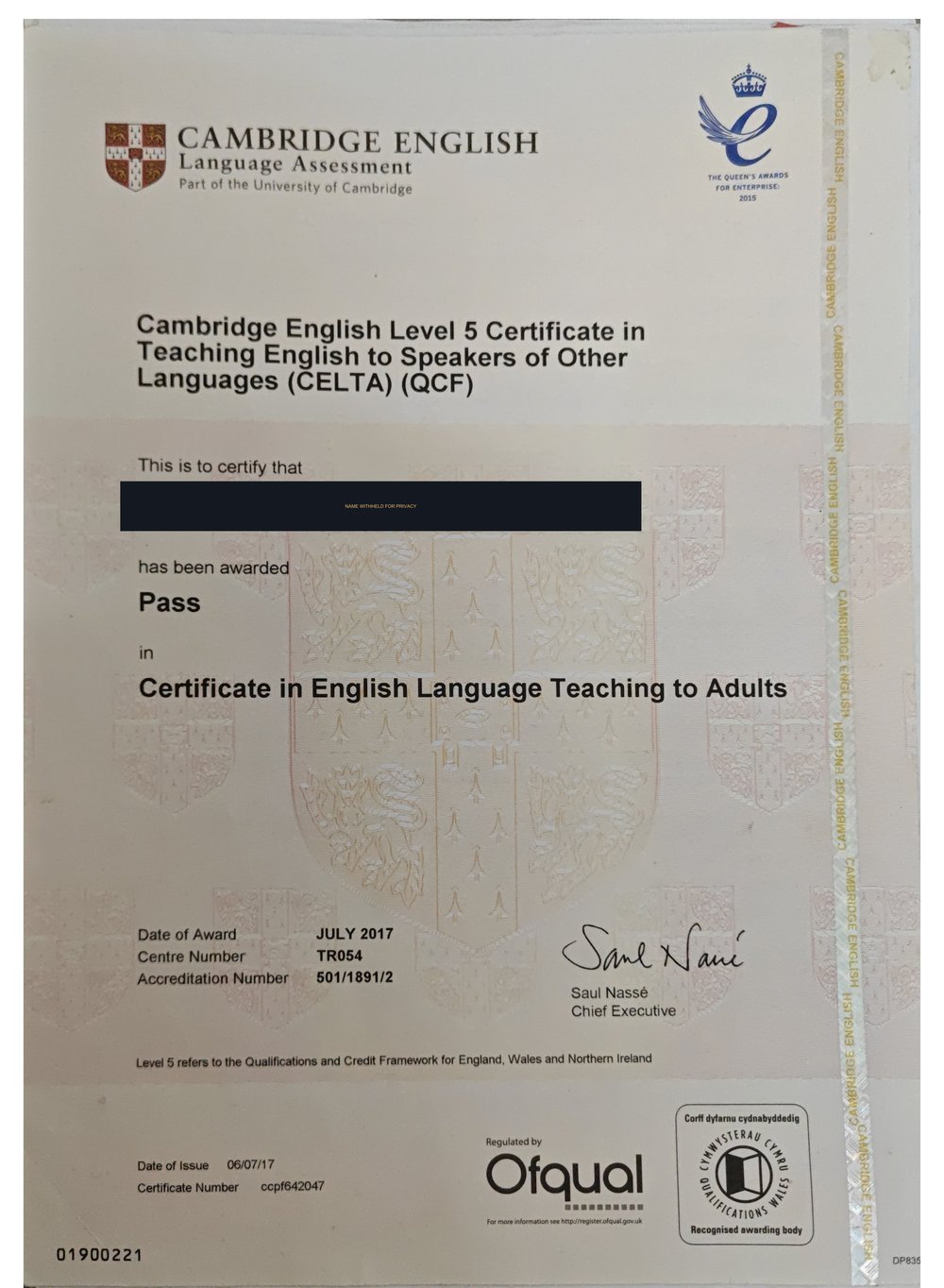
Mike holds the Cambridge CELTA (July 2017), is based in Hanoi, Vietnam, and has 12+ years of teaching English and IELTS in Vietnam, Turkey and Iran. His own IELTS result is 8.5 in Speaking. He teaches every session himself, one-to-one, live on Google Meet, in English.
Lessons cover IELTS Listening, Reading, Writing and Speaking. Mike marks Writing Task 1 and Task 2 against the public band descriptors and runs Speaking Parts 1 to 3 in the real format, with feedback in the moment. He leaves written progress notes in your account. Lessons do not set or promise any result, and they are not a way to apply to the Teaching Council. You can book a lesson or read about Mike first. The booking calendar shows each slot in your own time zone; Ireland is 7 hours behind Hanoi in winter and 6 hours behind in summer.