The facts about the test and about PayPal below were read on 11 November 2026 on ielts.org, IDP, the British Council, the immigration authorities' own pages and PayPal's Philippines pages. They change, so confirm them at the source before you book or pay.
IELTS one-on-one tutor Philippines? Yes, you can learn online from Manila, Cebu, Davao or anywhere else
These lessons are online, so the city you live in affects your clock and your nearest test centre but not who can teach you. You sit at your own laptop in Manila, Cebu, Davao, Iloilo, Baguio or anywhere with a steady connection, and the lesson is a live call with Mike, one-to-one by default.
The cities in the test section below are test-centre cities from the organisers' lists; Band Booster has no centre in any of them. For how lessons work in general, read the online IELTS tutor page.
IELTS teacher Philippines: meet Mike, who teaches IELTS Speaking on Google Meet
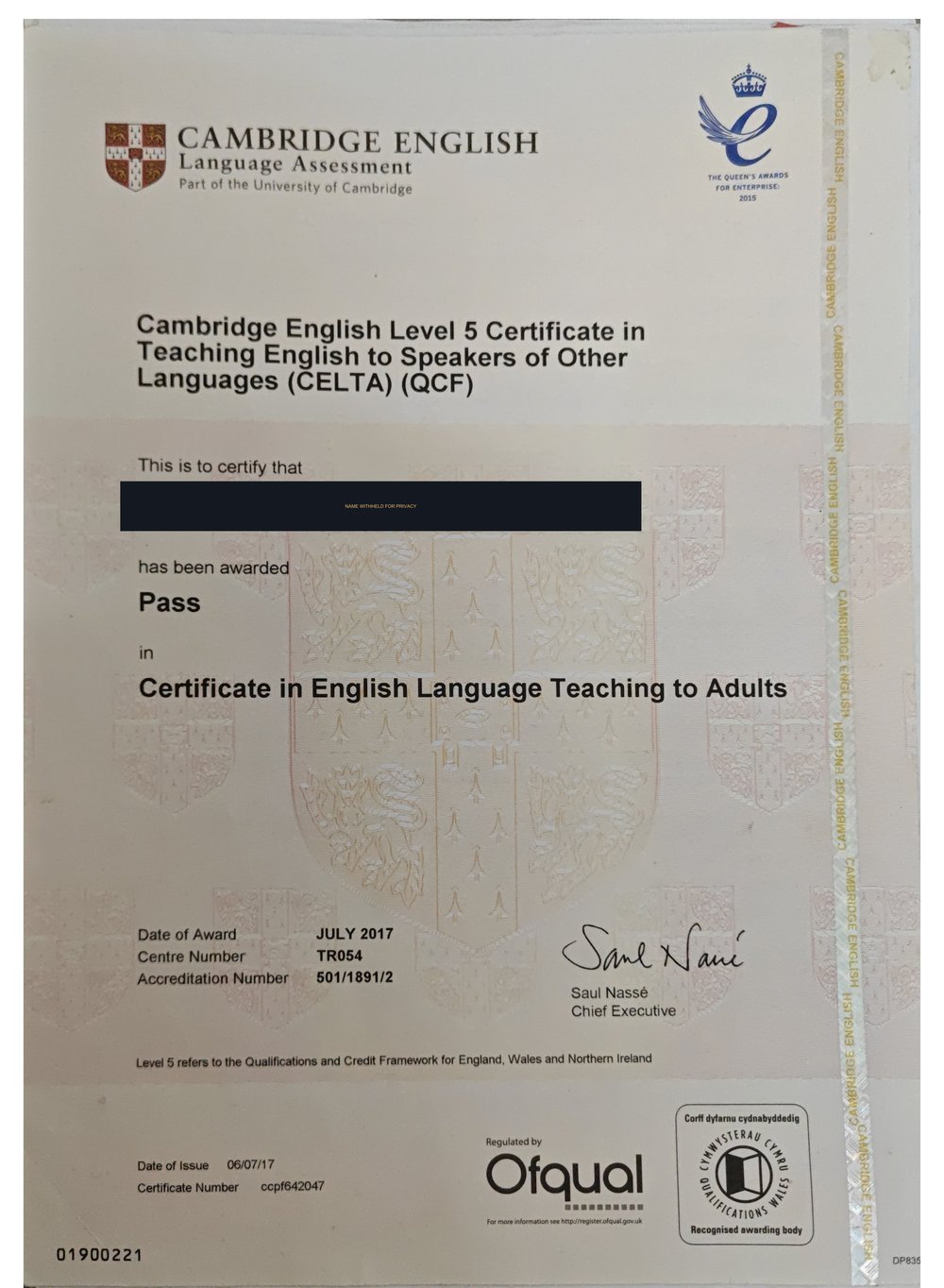
Mike has the Cambridge CELTA (July 2017) and teaches from Hanoi. In more than 12 years he has taught English and IELTS in Vietnam, Turkey and Iran, and he has now given over 500 one-to-one sessions. In his own IELTS test he scored 7.5 overall and 8.5 in Speaking. Mike teaches every lesson himself; see About Mike and the IELTS Speaking coaching page.
Three results have been reported back to Mike, each anonymous: 6.0 to 7.5 overall, 5.5 to 7.0 in Writing and 6.5 to 8.0 in Speaking. No band is promised: where you end up depends on where you start and what you practise between lessons.
Time difference: Manila runs one hour ahead of Hanoi
According to the IANA time zone database, Manila (Asia/Manila) sits on UTC+8 and Hanoi (Asia/Ho_Chi_Minh) on UTC+7. The last Philippine daylight-saving rule in that database is from 1990, and Vietnam has kept UTC+7, with no daylight saving, since 1975. The gap therefore never changes: 19:00 in Manila is 18:00 in Hanoi.
| Philippine time (UTC+8) | Hanoi time (UTC+7) |
|---|---|
| 07:00 | 06:00 |
| 12:00 | 11:00 |
| 17:00 | 16:00 |
| 19:00 | 18:00 |
| 22:00 | 21:00 |
Read the table as a clock conversion, not a timetable. Which hours are open depends on Mike's calendar and none are promised; the booking calendar shows every slot converted to your own time zone.
What a lesson covers: Speaking, Writing, Listening and Reading
- Speaking: Parts 1, 2 and 3 practised as they appear in the test, with comments given as you go instead of days afterwards.
- Writing: Task 1 and Task 2 are marked against the public band descriptors.
- Listening and Reading: both can be worked on in the same sessions if you want them included.
Lessons are in English throughout; if you are unsure whether the level or format suits you, message Mike before booking. A standard lesson is 60 minutes, and you can choose 2 hours instead. Lessons can be recorded if you ask, and written progress notes appear in your account afterwards.
What does an online IELTS review in the Philippines with Mike cover?
If you searched for an IELTS "review", here is what that looks like at Band Booster IELTS. A review with Band Booster IELTS is one-to-one by default rather than a fixed course: you and Mike pick the skill that needs work, whether that is Speaking Parts 1 to 3, Writing Task 1 and Task 2, Listening or Reading. He gives feedback during the lesson, and written progress notes appear in your account afterwards.
There is no classroom or centre in the Philippines, no subscription and no required number of sessions, and nobody you do not know joins the lesson. If a test date is near, several sessions can be booked in one week as long as slots are open. Adults can also use the site's AI Speaking practice between lessons for practice feedback, which is not an IELTS score (the practice screens and the report are in English only); how far you get depends on where you start and what you practise, and no band or timeline is promised.
Taking IELTS in the Philippines: what ielts.org, IDP and the British Council say
The test itself is booked with an organiser. Band Booster is independent of IDP and the British Council: it does not register candidates, set fees or issue results.
- Where: the ielts.org test-centre finder showed 67 results for the Philippines once the country is chosen: 66 test-centre cards and one IELTS Online entry (some venues repeat, so cards are not buildings). Its city filter includes Manila, Makati, Quezon City, Cebu, Davao, Iloilo, Baguio and Cagayan de Oro, among others, and it lists IDP centres in Manila (Sampaloc), Makati and Cebu Business Park and British Council Manila in Bonifacio Global City.
- British Council: its Philippines page says it offers test dates in over 20 locations nationwide, at a test centre or, for IELTS Academic only, as IELTS Online from home with a stable internet connection.
Computer, and the end of paper
The British Council's Philippines page says it no longer offers IELTS on paper in the Philippines from 21 June 2026, a date that has passed. IDP's announcement (dated March 2026, global, not naming the Philippines) says paper-based IELTS ends from mid-2026 and that exact timelines vary by market. Most cards on the ielts.org Philippines list show Computer, and one British Council Manila card also shows a Writing on Paper option. Check the format on the provider's page for your own booking.
Speaking, results, ID and retakes
- Speaking: IDP's Philippines page on IELTS on computer says Speaking is held over Zoom; the Speaking section below has the detail. Confirm how it is held for your booking.
- Results: IDP's page says 1 to 5 days, and the British Council's results page says computer results typically take 1 to 2 days. These are typical timings, not promises.
- ID: IDP's Philippines registration guide lists the IDs it accepts: a passport valid for at least six months before the test date, the Philippine National ID (card version only), a PRC or SSS ID that shows a date of birth, a GSIS ID and a UMID. It says to bring the same ID you registered with, and that failing to show it means losing the test fee. The British Council sets its own steps on its Philippines pages.
- One Skill Retake: the British Council's page and IDP's guide both list it; see IELTS One Skill Retake and check eligibility with the provider.
- Fees and dates: both change, and both are on the providers' pages; no exam fee or test date appears here.
IDP's guide also says to ask your institution which test type and band score it requires, because requirements vary by course or profession; see Academic or General Training and IELTS scores for study abroad.
IELTS for Filipino applicants: what the official pages say about acceptance
The British Council's Philippines page says IELTS is accepted for higher education and for migration. ielts.org says immigration authorities in Australia, Canada, New Zealand and the UK accept it, and that score requirements may depend on the visa. What the authorities said when read on 11 November 2026:
- Australia: the Department of Home Affairs' Proficient English page lists IELTS Academic and General Training for the Proficient English level (one of the English levels the Department uses for some visas), and says tests delivered completely online, IELTS Online included, are not accepted there; the page also says some visas allow other forms of evidence.
- Canada (Express Entry only): IRCC's Express Entry page lists IELTS, says to take the General Training option, and does not accept One Skill Retake for Express Entry; other Canadian programmes have their own pages.
- New Zealand: the Accredited Employer Work Visa page (for roles at skill level 3 to 5) lists IELTS among accepted tests and says tests taken remotely, such as at home, are not acceptable.
- United Kingdom: GOV.UK's secure English language test page names IELTS for UKVI. GOV.UK's Appendix English Language lists the majority-English-speaking countries whose nationals meet the requirement by nationality for the routes it covers; the Philippines is not on that list. The appendix also sets out other ways to meet the requirement, so that fact alone does not say whether you need a test; check the rules for your own route.
This page is not immigration advice. Whether English must be shown, and at what level, depends on your visa and route, so check the authority's own page. The Australian page names IELTS Online as not accepted, and the New Zealand page says tests taken remotely, such as at home, are not acceptable, so check this before booking a home-based test. See also IELTS scores for study abroad.
IELTS Speaking in the Philippines: how IDP holds it, and how to practise
IDP's Philippines page on IELTS on Computer says Speaking is done via Zoom with a live IDP examiner, with face-to-face Speaking still available for people with special needs. The ielts.org format page calls it a face-to-face interview with an examiner, 11 to 14 minutes, in three parts. The two pages word delivery differently, so confirm on your own booking how Speaking is held. This section covers IDP only; check the British Council's page for how it holds Speaking.
In our view (an inference, not something either page says), a live conversation with a person is a reasonable way to rehearse Parts 1 to 3, whichever way your test is held. In a lesson with Mike, practice runs over Google Meet with feedback during the session. A lesson is practice, not an IELTS test, and does not reproduce a test's platform or conditions.
Need an IELTS writing tutor online in the Philippines? How Mike marks Task 1 and Task 2
Yes: Band Booster IELTS gives IELTS writing correction in lessons with Mike, who holds the Cambridge CELTA and teaches every lesson himself. You bring a Task 1 or Task 2 answer, he reads it against the public band descriptors, and you go through the corrections together on Google Meet. Written progress notes appear in your account afterwards.
Task 1 describes a chart, graph, table, diagram or process in Academic and is a letter in General Training, while Task 2 is an essay and carries twice the weight of Task 1 in the Writing band. To practise before you book, the AI Writing checker on this site gives adults practice feedback on a typed answer, with the first marking on your account included; it is not an IELTS score, and the practice screens and the report are in English only. How a corrected session works is described on the Writing feedback page.
How to book and pay from the Philippines
- Choose a time in the booking calendar; it is shown in your own time zone.
- See your price on the booking page, then pick from the payment options listed there (PayPal and USDT on TRC20 or BEP20 are among them).
- When the payment is confirmed, an email brings the Google Meet link and a calendar invitation.
- Meet Mike online at the time you chose.
- Find written progress notes in your account after the lesson.
PayPal's own Philippines help pages say three things worth knowing. The page on paying in another currency says PayPal calculates the conversion rate and shows it when you pay, and that card payers may be able to choose their card issuer's rate instead. The page on sending limits says an unverified account has a limit on the total it can send, shown when you go to send money, while a verified account has no limit on the total. The general sending page says features can differ by market. Lessons paid by PayPal are charged in US dollars, and a USDT payment is worked out from the same dollar rate, with the exact USDT amount shown when you reserve your time. Whether PayPal works depends on your own account, so choose the option on the booking page that works for you. Band Booster never sees or stores card details, and nothing is a subscription or a required pack.
Price
The Price box on this page shows the 60-minute lesson and the paid 30-minute trial in Philippine pesos, and the booking page repeats the exact amount before you pay. The paid trial is for your first booking only. You can reschedule without charge up to 24 hours before a lesson; cancelling inside 24 hours earns no refund. The IELTS exam fee is a separate matter between you and the test provider.
Group class or private lessons?
A class gives you a set timetable and other students; one-to-one lessons centre on your own Speaking answers and Writing, at times you pick. The guide to choosing an online IELTS tutor lists the questions to ask each option.
Want to see which times are open? Go to the booking page.